Posted in Tips and Ideas

Are You Ready To Hand Over Your Pricing Strategy?

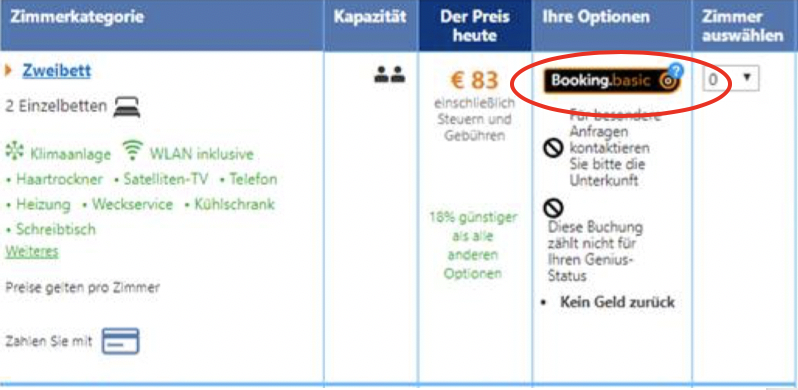
If you’re in any way involved in your hotel’s online distribution you’ve most likely come across Booking.com Basic by now. Through this programme, Booking.com pulls wholesaler rates to sell publicly on their platform. The programme is neither on an opt-in nor an opt-out basis – participation isn’t negotiable. The concept isn’t new, the likes of Amoma have been bothering hotels for years with this strategy. The difference is that on Booking.com it will have a significant impact on your hotel’s business.

Now, there is an obvious and easy way for hotels to avoid being pushed into the programme – to simply stop distributing static, opaque wholesaler rates. Might be easier said than done though if your hotel is dependent on that FIT business or even tied to a contract, but at least there is a way out.
The bigger concern: Early Payment Benefit

I would actually argue that the Early Payment Benefit (EPB) test that Booking.com is currently running in several major cities in Europe is much more concerning. With this initiative, Booking.com discounts the rates hotels send to them by taking part of their commission margin. In essence, Booking.com is now actively deciding what the price for a room should be. They have determined, that you, as a hotel, are no longer the one to decide how much a guest should pay for one of your rooms.
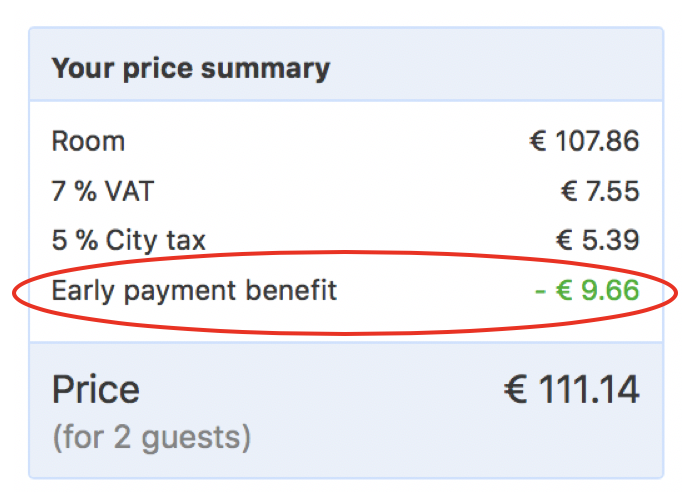
The critical difference to Booking.com Basic is that there is absolutely nothing you can do to prevent it from happening other than closing the channel completely. Static FIT rates being distributed all over the place were a kind of grey zone in terms of who’s to blame. For the EPB it is quite clear what is happening –

Booking.com is undercutting the rate you send them to offer a better deal to the guest.

Now once you raise this topic with Booking.com the response is (reactive, not proactive) that the there is no need to panic – the rate you’ve given them is also the one that you will receive e.g the hotel sends €100 to Booking.com, guest paid €90 but hotel receives €100.

For hoteliers with a short perspective there is indeed no need panic, but anyone with ambition to drive more direct bookings will know that this development is devastating for your hotel’s website contribution. In the last years OTAs have done a terrific job in terms of educating the public they get a cheaper price on an OTA than on a Hotel Website, despite that not being true most of the times. You don’t have to be a rocket scientist to figure out what will happen to your hotel website contribution when it is in fact true.

Why my hotel?

So why is this happening to my hotel? Well, Booking.com refers you to the Price Quality Score (PQS) screen on their extranet. Here, hotels are encouraged to provide “Fair Prices” to customers. If you are not fair, you will get a low score (and possibly penalized with an EPB discount).

It is not clear how the PQS is calculated and what is indeed fair prices. Arguably, it has something to do with rate parity. Taking our new independent hotel as an example: We distribute two rates, across 3 room types, on 3 channels. Everyone gets the same. There are no wholesaler contracts or opaque rates floating around anywhere and no sneaky discounts on OTA backends. In other words, it’s relatively straightforward (which is also the idea). I feel confident saying that our hotel probably provides some of the fairest pricing in northern Europe. As you may have guessed, our PQS is in the red.

What is fair?

So, we can conclude that Booking.com has a different definition than we do of what fair prices are. Now, in contrast to what Booking.com thinks, we like to think that we (the hotel) should still have some input on what our own product should be sold for. So we had to act. Through some research, we managed to find out what the discount pattern was of the EBP and consequently we are now matching that unfair (according to our definition) discount with a promotion set up on our other channels. That for us, seemed like fair pricing practice. Presumably, Booking.com won’t agree and it remains to be seen what impact this will have on our EQP. The good news is that we are almost at 0 now, so it really can’t get much worse.

The most troubling part of the EPB and Booking.com Basic is the message it sends to hoteliers – that you are no longer in charge of your own pricing. This, I think, will be hard to swallow for hotels, especially those, that have net revpar, book direct and advanced revenue management strategies in place.

It should be mentioned that Booking.com is not alone in pursuing this strategy. The Add On Advantage on Expedia and Coupon Discounts on Agoda are other programmes that undercut rates by cutting into their commission margin or sourcing third party rates. However, few will have an impact as signficant as Booking.com, at least in European markets.

I’d be keen to hear from the fanatics that were screaming for rate parity laws to be removed in the last few years. I am not sure if they considered that it obviously goes both ways, and we are now finding us in a situation where hotels have even less control of their pricing than ever before.

I’ve always said that I find Booking.com less partner and more (end) customer focused than for instance Expedia, and that that approach makes sense to a certain point. I am afraid though that Booking.com has crossed the line with these latest developments and may end up alienating many of its partners. The hotels that decide to accept Booking.com’s definition of fair and hand over their pricing strategy may want take a good look in the mirror and ask themselves: who’s actually in control?

Do you want to know more details about personal concierge app then please contact us in the comment section and get the answers of your questions.

Posted in Tips and Ideas

It’s Time To Focus On Your Mobile Website

With the unstoppable increase in mobile traffic, hotel marketers need to focus on the experience of guests visiting their website via smartphones. But is your mobile website ready to do its share when it comes to your direct bookings?

What we know about mobile

Hotelchamp data scientists frequently analyse trends and browsing habits amongst devices. Our data shows that Mobile sessions on hotel websites have exploded in the last two years: from 32% at the beginning of 2016, to 52% in August 2018. This means that visitors are now using Desktop and Tablet considerably less. In fact, data shows that mobile sessions have overtaken desktop and that tablet sessions have seen a particularly sharp drop.

But while travellers are increasingly researching accommodation on mobile, they aren’t concluding their bookings via mobile. Data analysts found that 68% of bookings were still made via desktop in August 2018, whilst mobile accounted for 21.8% of the bookings. Consequently, hotel conversion rates are on average 6.3x better via desktop than on mobile devices.

The implications are clear – there is no denying the importance of giving your mobile website the attention it deserves. The user experience on mobile is extremely important, as this is where many of your guests are looking for information.

What you can do

Hoteliers can create mobile-specific tools that inform travellers of the benefits of booking direct. These tools can persuade more customers to conclude their booking directly on your mobile website. In addition, visitors who still prefer switching to a desktop device to book their stay will already be better informed about the reasons to book direct.

Hotelchamp has recently introduced new-look mobile tools, designed specifically to increase the conversion of guests visiting via mobile.  With seamless website integration, proven results and powerful customisation, Hotelchamp’s tools will optimise the customer journey on your website – across all devices.

Here are 2 examples of tools you can add to your mobile website and booking engine to highlight your direct booking benefits:

Offering a promo code

Using Mobile Websites, you can highlight specific offers or selective discounts by providing a promo code. Mobile functionality allows you to first unobtrusively introduce the offer as a tap-to-expand icon – it offers a range of 1000s of icons to choose from, to best suit your offer. Once the visitor taps the icon, the full message will appear.

The visitor can then tap the ‘book now’ button, to be taken straight to your booking engine where the promo code is already applied, taking them one step further in their booking journey.

Compare prices

Once the traveller is already in the booking engine and has selected their date of stay, Price Comparison tool can compare your direct price to that of your OTA prices. This tool intelligently knows to only show when your direct price is cheaper, and is a great way to persuade your website visitors to book directly on your website.

Do you want to know more details about travel concierge app then please contact us in the comment section and get the answers of your questions.

Posted in Hotels and Resorts

Four Steps Towards A 2019-Ready Hotel Website

Today, the internet offers more travel information than ever before. But it also makes the research, planning and purchase steps of the guest journey more complex. Travelers became more accustomed to responsive web pages, memorable content and moving images. That’s why they will also expect it from your hotel’s website.

For hotels that want to capture more direct bookers, a responsive, visually stimulating and fast-loading webpage is crucial. Sites with content that takes too long to process might find it hard to win over the direct bookers in 2019.

As a Customer Success Coordinator at Triptease, I often consult our clients on the latest website trends. Here are the top four must-haves for a better website experience that drives more direct bookings.

1. Make your website responsive

The number of smartphone users is expected to grow from 3 billion in 2018 to 3.8 billion in 2021. Last year, the internet was accessed on smartphones more than 58% of the time, and 51% of page views were generated from mobile devices (Phocuswire). Nearly 28% of bookings came from mobile devices (HEBS Digital client portfolio data).

As more people rely on their smartphones to book their trips, build a seamless mobile experience for your website guests. A booking process that is not mobile-friendly can turn away your potential guests. 85% of adults consume content on multiple devices at the same time, so make sure that your hotel website adapts to all screen sizes to maximize the likelihood of capturing a direct booker!

2. Review your content

Gone are the days of static images showing empty rooms. The imagery where the customer interacts with the product (in this case, a stay at your hotel) increases engagement. For a hotel website, it would be most impactful to use the images of people having a good time at their trip, interacting with other people, having a relaxing moment, or dining on delicious food.

To drive more direct bookings, try to offer more engaging website experiences than on OTA websites. For example, 360 tours of your property can increase the time that the traveller spends on your website.

Keep in mind that the imagery you choose should be harmonious with your hotel brand. Ideally, every aspect of your visual content – from location to objects and even to people – should match your hotel’s identity, destination and the website’a colour scheme. Don’t forget about the style of our campaigns and messages. You can customise colors and images on your pop-ups to keep your offers on-brand.

In today’s fast-moving world, visitors spend on an average around 15 seconds on a web page before they leave. The written content on your web page should be short and informative to keep the visitor interested. 20% of users will read the text, whilst 80% will watch the video with the same content. Make sure you tell your story with visuals and keep the text short and impactful.

3. Provide social proof

It is embedded in human nature to follow the crowd. That’s why we as humans want to be reassured that we make the right decisions.

A staggering 91% of visitors rely on traveler reviews before committing to an online purchase. To impact their decision, try displaying positive guest reviews where you want them to book – on your hotel’s webpage.

Today’s travelers often rely on social media platforms to provide them with travel inspiration and reviews. Investigate your audience and establish your hotel brand’s presence on their popular social sharing channels. Publish your own videos and photographs, share information about the upcoming events and offers, and encourage the social media users to leave reviews and go to your website!

Make the most out of the user-generated content (UGC). Hamilton Island, for example, have tripled their ROI with their UGC strategy. “At times, as marketers, we are guilty of undervaluing UGC compared to professional brand photography,” says Aida Merdovic, Director of Online at Hamilton Island, in the interview “Arguably, given the right lighting and situation, an amateur Instagram user can capture a more impactful and meaningful shot than a professional photographer. I believe that some moments simply are unable to be staged – and authentic, UGC moments often have strong resonance with followers.”

4. Embrace your location

Your guests are likely to want to know about what is going on around in the hotel’s neighborhood. Providing relevant information about your hotel’s location can persuade the website visitor to book their stay at your hotel. You developed location notifications that highlight your hotel’s place on the map and local experiences around it.

Keep in mind that travelers look for different kinds of experiences. Distinguish between independent, social and habitual travellers to present them with personalized offers on your website.

Implement all these steps to keep ahead of your competitors, increase traffic and drive more direct bookings on your hotel’s website. And if you are a client in need of a consultation on the latest website trends, our Direct Booking Coaches are can always advise you on how to improve your website guest experience!

Do you want to know more details about hotel concierge app then please contact us in the comment section and get the answers of your questions.

Posted in Tips and Ideas

5 Major Guest Complaints That A Cloud PMS Can Resolve

Today’s hotel guests are more aware and informed than ever before. They know their rights and will not settle for anything less than what they expect from a hotel. Most importantly, they also know how and when to vent their displeasure, if not served properly. In this context, small and independent hotels need to be a little more cautious while handling guest complaints. Because bad or negative guest reviews can really break a small and independent hotel’s brand reputation. That’s why they need to go the extra mile to offer a timely solution to guest complaints to earn their trust and loyalty.

During their stay at hotels, guests complain about many things including unstable Wi-Fi, no hot water, musty rooms/toilets, noise from the next room, bad food, unfriendly staff and many more. If you run an independent hotel in any part of the United States, I am sure that you must have seen some of your guests picking up on some of the points listed above, while expressing their discomfort. While you can tackle some of these guest complaints on your own, you would still need to leverage the power of today’s smart hospitality technology solutions to make sure that your guests are happy with you throughout their stay.

Let’s now look at 5 major hotel guest complaints and how you can effectively address them at your independent hotel with the help of a Cloud Hotel Property Management System (PMS).

#1 How much longer until I check-in?

Yes, we are talking about long waiting time at the lobby before a guest checks into the room. Regardless of where in the world a hotel is, guests will not be pleased if asked to wait endlessly to be checked in to their rooms! And why not? Who would not be in desperate need of rest or hot shower after a tiring journey? See this – according to a report by Cornells’ Center for Hospitality Research, hotel guests in the United States would not appreciate it if you make them wait for more than 5 minutes and it results in a 47% decrease in guest satisfaction. This is an issue your staff will have to deal with carefully and skilfully.

Whether this is due to the room not being ready, or simply lack of clarity on a reservation, the onus lies on you. In this case, you need to speed up the check-in process at your property. And to ensure this, you can adopt a cloud Hotel PMS. Just open the quick reservation panel, enter the first and last name of the guest, simply drag and drop to finish the check-in process. The guest walks into the room in no time and voila! You are done.

Moreover, many cloud PMS vendors can help you with a Mobile Hotel App. You just need to scan the guest’s identification document to perform a direct check-in. This way, you can help your guests to bypass the front desk.

#2 My room was not clean

Cleanliness of the room is one of the most important parameters for your guests to judge your hotel and your services. Just take a look at US hotel guest reviews on various sites. You will find most of them complaining about unclean rooms with a damp smell.

Here is how a Hotel PMS would help you with this. For example – a smart cloud PMS like Hotelogix will not allow your front desk staff to check-in a guest if the room is marked as ‘not clean’ by the housekeeping. Front Desk staff get to see the current room status. If a guest raises such requests, you can assign tasks to your housekeeping staff from the Front Desk. You can also track the progress of the assigned task and get to know if the issue has been addressed on time.

#3 I have stayed here twice before, yet they don’t know me

This clearly means that you don’t have a guest history management mechanism in place. Without this, you will never get to recognize and understand those guests who have stayed with you in the past. Your repeat guests would like it if you offer them the type of room they opted for during their last stay even without asking. They would appreciate it if you serve them their beverage of choice.

See this – around 65% of guests would appreciate it if you know them and their preferences.

But, how will you serve repeat guests better if you don’t understand their requirements?

Here’s where a cloud hotel PMS can help you with better handling such issues. Everytime a new reservation is being done, when your front desk staff enters the first name of the guest, the PMS will throw up a separate page containing all the information if the guest has stayed with you in the past. This will let you know their preferred room, food & beverage choices, other likes and dislikes and many more. This way, you know what needs to be done in advance to make the guests happy with personalized offerings.

Just imagine this – your guest history record lets you know that your guest Michael John has asked for airport drop during his last stay. Don’t you think that he will be happy when you inform him that you have already arranged an airport drop for him even before he checks out?

#4 Why can’t I just pay everything in my final settlement?

In such cases, the guest complaint is that they need to carry their wallet every time they step out of their room at your hotel. Each time they head to the restaurant to grab a meal, to the bar, or any other POS outlets at the hotel. Obviously, this is an inconvenience and guests are most likely to be displeased with such an arrangement.

Rather, they would appreciate it if you allow them to pay all the additional bills from the restaurant, the bar, the gym and others in one final settlement during the checkout. This gives them so much more flexibility and allows them to pay for everything in one go.

Well, you can always consider adopting a smart cloud-based Hotel PMS that comes integrated with a Point of Sale module to help your guests with this, too. This would allow you to post all the bills to the guest room. Let your guests enjoy your hotel facilities without worrying about paying every time at all the outlets. They just have to pay the final amount during the checkout. This way, you can offer your guests a frictionless stay at your hotel.

#5 My reservation is not honored

So here, we are dealing with overbooking or double-booking issues. Sometimes, as a hotelier, to guard against unforeseen last-minute cancellations, you might adopt overbooking strategy. There is nothing wrong with it as long as you make sure this is dealt with carefully. However, if you are not able to update your inventory on multiple OTAs in real-time, you end up facing overbooking issues, too. This means you have to dishonor some reservations and turn away some of your guests which leads to guest dissatisfaction and loss of brand value.

Look into the capabilities of a cloud hotel Property Management System to overcome this issue. Here is how it can be of immense value to you. Being on the cloud, the PMS gets easily integrated with a channel manager that is also on the cloud. Through this integration, you can update your rooms and rates across several OTAs, in real-time. This instant distribution of rooms on OTAs ensures that there is no overbooking at your property. Zero overbooking means no more irate guests, nor is there the possibility of negative reviews, from those irate guests, on hotel booking platforms.

In today’s highly competitive hotel business, handling guest complaints and offering them the right services is the key to success. While a smart cloud-based Hotel PMS can help you address the above-mentioned issues with ease, you also need to invest in your staff to sensitize them on how to offer the ‘human touch’ whenever they interact with your guests. Because, despite all the technological advancements in the industry, human engagement plays a critical role when it comes to guest service. This makes it all the more necessary for hoteliers to invest in a cloud PMS as it frees up a lot of time for you and your staff, so you can focus on delighting your guests.

Do you want to know more details about concierge service app then please contact us in the comment section and get the answers of your questions.

Posted in Tips and Ideas

Hotel Content Ideas That Turn Browsers Into Bookers

When you’re up against big brands and even bigger OTAs, it can be hard for your hotel website to stand out. For a potential guest, compelling content can mean the difference between “just browsing” and booking. So how do you come up with great hotel content ideas?

Consider whether your hotel website is knocking down the most common barriers to booking. Do your hotel room descriptions offer a compelling value proposition? How about a visitors’ guide to your destination? To help you attract (and ultimately, convert) your ideal guests, we rounded up lots of hotel content ideas along with the best examples below.

Highlight Your Destination & Local Experiences

Culinary travel, pop culture, and off-the-beaten-path recommendations are shaping experiential travel in 2019, according to the travel experts at Skift. When it comes to destination-focused hotel content ideas, think about curating the local experiences your guests would love if they booked your property.

CITYWIDE EVENTS

One of the best places to get hotel content ideas is your city’s annual event calendar. A “citywide” can be a professional conference, sporting event, cultural festival, music concert… anything that attracts a group of visitors, really!

If you know that people will be traveling to your destination to attend a citywide event, create a blog post or dedicated landing page for it. Think about what information would be most helpful to someone attending for the first time, like the Aqua Soleil Hotel’s Ultimate Coachella Survival Guide. Hotels can also consider providing context to major spiritual or cultural events, like Holiday Inn Resort Phuket does with their guide to Songkran Do’s and Don’ts.

Pay close attention to recurring citywides and plan to update your content periodically. This will ensure your page ranks well on Google and keeps working for you long after this year’s event has ended.

MAKE A LIST

One of the easiest ways to get started creating content for your hotel is to utilize this simple, popular format. Coming up with creative content ideas for your hotel can feel overwhelming, which is why we (and pretty much everyone else) love a good list. Lists are easy to read, understand, and share.

This content format works especially well when you want to position your property as a go-to resource for lots of local, reliable insights. Do you know where to find the best bagels in New York? Or how about ten unusual places in your town that tourists have never heard of? Where are the top bookshops, secret swimming spots, or craziest street eats? Think about what will be of the most interest to your guests and reach out to your hotel team for their input.

Content Ideas For Your Hotel’s Low Season

Many hotels and resorts struggle with marketing ideas for the off-season. How do you sell a beachfront property when the temperature drops? Or how about when the locals leave for vacation and the city feels completely empty? The content ideas below can help you get started marketing your hotel property during its low season.

SEASONAL PACKING GUIDE

Knowing that your hotel content needs to add value to prospective guests, a seasonal packing guide might be some of the most helpful information your hotel can provide! If weather or other seasonal factors are making potential bookers hesitate, address it head-on by showing them exactly what they need to prepare.

TELL THEM WHAT TO DO

We’ve already noted how local lists and travel itineraries are great ways to showcase your destination, but what about the off-season? Framing your content around specific need periods and times of low occupancy is a highly effective marketing tactic.

As the local expert on all things Your Destination, you can actually use content marketing to change the narrative when it comes to traditionally slow travel periods. For example, you’d think that no one wants to visit Bali during the rainy season, right? Well, the Colony Hotel lays out a number of great reasons why you might want to reconsider! Likewise, Marriott makes a compelling case for why many of their beach destinations are even better to visit in the off-season.

Useful Content Ideas For Guests Before They Arrive

Does your hotel website answer all of your guests’ burning questions? Stop them from opening yet another browser tab to Google your destination! Make sure you’re providing the necessary info they need to understand local transportation, cultural quirks, and more.

LANGUAGE CHEAT SHEET

Understanding a little bit of the local language can completely change a traveler’s experience. When you provide genuinely helpful content like a language guide, potential guests browsing your site can’t help but feel a sense of trust. Start with translating some of the following suggested phrases/greetings: “Hello!” “Thank you!” “Good morning/Good afternoon/good evening!” “How much does this cost?” and “Where is the nearest (train station/market/bathroom/etc.)”

PHOTOGRAPHY GUIDE

We know that people are using Instagram as a pocket travel guide. Google searches for “Instagram guide to (X Destination)” are also on the rise. You don’t need to be pro to enjoy sharing photos from your travels, so help guide guests to the most Insta-worthy local spots with a curated photography guide.

Content Ideas That Encourage Hotel Loyalty

Boosting your hotel’s online presence is not limited to merely attracting potential guests but must include continued engagement beyond check-out. Loyalty programs are an important component of any overall hotel marketing strategy. Try incorporating these easy content ideas to help nurture that loyalty and encourage guests to rave about your property.

SHOW OFF RECENT REVIEWS

Research shows that guest reviews do have an impact on hotel bookings. Encourage your guests to share their (hopefully glowing!) feedback on sites like TripAdvisor by mentioning it at check-out or during positive service interactions. Reviews from other guests are often the tipping point for other travelers in the decision-making phase of booking.

Using reviews in your content marketing can be done in many ways. Incorporate relevant testimonials about your wedding services on your Weddings & Events landing page, or try rotating recent 5-star reviews into your monthly email newsletter. Keep a close eye on recurring trends in your guest reviews as you could also find inspiration for future content ideas!

USE USER-GENERATED CONTENT

UGC (User-Generated Content) can be a little tricky to navigate sometimes but is still worth exploring. Your guests are actively sharing their experiences on social media — simply search your hotel’s geo-tag or official hashtag to find tons of user-generated content.

As a general best practice, if you’ve been tagged it’s perfectly OK (even encouraged) to engage! If their image and/or story is particularly compelling, reach out to the guest and ask their permission to share. If you have a hotel blog, consider making “guest stories” one of your ongoing content pillars.

Do you want to know more details about online concierge app then please contact us in the comment section and get the answers of your questions.

Posted in Tips and Ideas

The Real Cost Of ‘Free’ Cancellations For Hotels

Last-minute cancellations are logistical and financial headaches for hotels, but ones that have always been a necessary evil within the industry. After all, plans can change with no warning, volcanoes can spontaneously erupt, and other unavoidable occurrences mean that flexibility can be a deciding factor for prospective guests choosing your hotel. However, cancellation policy has evolved in recent years from a footnote on the booking confirmation to the basis of entire OTA marketing campaigns, designed specifically to position agencies as the most risk-free option for guests.

A recent study by D-EDGE into reservation revenue has shown that the overall cancellation rate across all channels has risen by 6% over the past four years, reaching a peak of almost 40% in 2018. That may sound like a death knell for predictable occupancy – and indeed it may be, for hotels who generate a large majority of their bookings through OTAs. The 40% average is heavily skewed by the high cancellation rates on reservations from Booking.com and other OTAs. In comparison, the study found that only 18.2% of direct bookings were cancelled in advance.

These statistics are unsurprising given the vastly different approach taken to cancellation policy by hotels and OTAs. While cancellations affect a hotel’s ability to forecast revenue and impact their income in real terms, they are used by OTAs as a marketing tool – one that benefits their growth, rather than hinders it. Flexible reservations are at the heart of how Booking.com sells rooms to its users, and a year-on-year increase of their cancellation rate is proof that their message is clearly resonating. How did we get to this point, and what can hotels do to take back control of not only guest acquisition, but also guest confidence?

A changing industry

It’s symptomatic of a market heavily dominated by third-party distributors that hotels are often forced into a tight spot that encourages them to prioritize short-term gain over long-term stability. We’ve seen it before with programmes such as Booking Genius, where hoteliers are encouraged to take part in a discount scheme in order to fill low-occupancy dates or access a ‘higher-quality’ group of guests. As a result of many of these initiatives, the immediate positive impact is often outweighed by the wider cost to the business of offering lower rates on an OTA than on the direct site.

In early 2018, Booking.com introduced ‘Risk Free Reservations’, a service which offers hoteliers the opportunity to enhance non-refundable bookings with free cancellation. If the original booker changes their reservation, the OTA will attempt to find an alternative guest to replace them before the stay date. If a new visitor cannot be found, Booking.com will take the monetary hit and pay the hotel for the empty room. In the short term, this may seem like a great deal – as well as greater visibility on the OTA’s index (hotels with non-refundable rates will still appear when a guest filters by ‘Free Cancellation’), hotels can stay competitive whilst guaranteeing occupancy or, at the very least, compensation for a last-minute cancellation that cannot be fulfilled.

The ‘Risk Free Reservations’ policy is born out of the core aim of making the booking experience as painless as possible for guests – something that both hotels and OTAs are firmly aligned on. OTAs have introduced programmes like ‘Booking Genius’ and ‘Risk Free Reservations’ to achieve this, but it has to be remembered that their ultimate goal is to ensure customer loyalty to their own brand, not to maximize the profit of the hotels they partner with. This means that while the programmes have some benefits to hotels, they can also have a number of unforeseen consequences that can cause concerning long-term challenges.

The long-term cost of short-term gain

In reality, ‘Risk Free Reservations’ have the potential to damage a hotel’s brand integrity, increase their dependency on third-party partners and ultimately hurt their bottom line in the long run. Mirai’s excellent article, published when the scheme was first announced, makes clear how ‘Risk Free’ rates on Booking.com can undermine your own hotel’s direct prices as they cannibalize more expensive flexible rate. The programme could also cause confusion if Booking.com has rooms available when even your own website does not, resulting in long-term reputation damage that significantly outweighs any short-term benefit.

‘Risk Free Reservations’ lead to disparity between Booking.com and direct sales (source: Mirai)The rise of cancellations is a symptom of a growing imbalance of power between hotels and OTAs. Even beyond landmark policies like ‘Risk Free Reservations,’ OTAs are constantly shaping the ways in which guests approach the task of booking a hotel, at the expense of the hotels who supply them. Drawing on ecommerce tools from other industries, OTAs have shifted the hotel buying process from a tailored, measured and personal one to an experience designed to make guests book as fast as possible or risk missing out. The ideal hotel website journey combines these elements, with an emphasis on guest satisfaction at the center of the experience – but OTAs are actively encouraging potential guests to ‘book first, ask questions later’. Without strategic investment in offering guests an attractive, viable alternative booking option to OTAs, hotels will continue to be at the mercy of the expectations OTAs set in the minds of guests.

Taking the power back

If hotels are going to decide the future of their own industry, short-term incentives have to be balanced against the need for long-term stability – and for the majority of hotels, long-term stability will require a self-sufficient channel of direct booking revenue. However, while you can invest in the most descriptive, engaging and intuitive website possible, guests will never choose you if are ‘offering an intermediary better conditions than your direct sale’. Cancellations are the most pressing example of this, and the perfect place to start for any hotels looking to grow their direct sales with the best possible proposition they can offer to prospective guests.

Firstly, while it’s the hotel that is most acutely affected by the impact of cancellations, it’s also the hotel that sets its own terms. It’s clear that a more proactive approach is needed – it’s down to you to dive into your own data and see how cancellations across different channels are affecting your hotel’s revenue. If you’re part of the ‘Risk Free Reservations’ scheme, it’s also worth comparing the quality of replacement bookings against non-refundable guests – you may be surprised by what you find. If you’re being stung by the financial impact of late cancellations, consider setting stricter policies in terms of dates or rates for bookings, such as non-refundable or flexible until a certain time before check-in, is a start – as is opting out of any schemes such as the ‘Risk Free Reservations’ programme. The pressure from OTAs and the competition within the industry may be significant, but the long-term reputational and financial benefits far outweigh any short-term challenges.

Use Targeted Messages to give guests a bespoke incentive not to cancel their bookingNext, engaging with the reasons why people are cancelling is crucial. Make the most of the statistics at your disposal – for example, what percentage of bookings are being cancelled, by who, in what rooms, and from what source? While this shift in the industry means it’s easier than ever to change a booking, each cancellation is still done for a reason. Ensuring you’re offering the best possible price to guests is vital, and sometimes reaching out to reluctant visitors is the only way to identify issues that are causing people to lose confidence in the service you provide.

Once you are confident that direct booking offers guests the best possible deal, the next step is to foster their trust. Cancellations take place primarily because that visitor does not believe your hotel can handle their needs, and so demonstrating excellent, personalized service from the outset is a sure-fire way to remove any lingering doubts. Utilising the Targeted Messaging and Chat features within Triptease gives you a way to engage with prospective guests and their questions directly, as well as to offer discounts and promotions that help them to make up their mind well in advance. It’s incredibly hard to control and curate the customer journey on third-party websites, and so providing guests with confidence in your hotel from the outset is an incredibly effective way of securing their patronage.

Create a true connection with your guests

It’s easy to forget that guests dislike uncertainty as much as hoteliers do. Juggling multiple reservations and being unsure of where you’re going to be staying during a business trip or a holiday is a stressful experience, and one that people would generally like to avoid. As the cancellation statistics continue to grow, and OTAs carry on making the likes of ‘Risk Free Reservations’ an integral part of their brand, it can be easy to lose sight of the fact that this is not just an inevitable industry trend that must be accepted.

Beyond all else, hotels hold a massive advantage over OTAs in terms of providing an engaging journey for guests during the booking process. With millions of hotels to juggle at once, OTAs can never understand a guest and their unique needs with the same level of compassion, commitment and care that a hotelier can. Guests need a hotel they can trust, and there’s no better way to build this confidence than by giving them a personalized experience that they simply could not get elsewhere.

Do you want to know more details about hotel mobile app then please contact us in the comment section and get the answers of your questions.

Posted in Tips and Ideas

On-Page SEO Tricks For A Hotel Website

The term “On-page SEO” usually applies to a set of practices you can use on your web page to improve its rankings and make it more visible in searches. Many years website owners believed that it’s enough to drop some high-volume keywords in the strategical places of a website (like the first paragraph of the tex, its title, and descriptions) – and you’re done.

But with the improvement of Google’s search algorithm, everything is not that straightforward. When you’re doing the on-page SEO for your hotel site, you should take some peculiarities into account that will help you to outrank your competitors in this niche.

Here is a set of on-page SEO recommendations for hotel website owners that help them to boost their rankings in search engines and drive more traffic and targeted customers to their sites.

Do keyword research

Finding the right keywords and phrases that people use in their search for a hotel online is essential for a website owner. Think of how people can search for your website, what phrases can they use? Remember, that people may not type your brand name into the search field (because they don’t know of you yet), so try to figure out their search phrases.

One of the best ways of brainstorming a bunch of good keywords is using Google Autocomplete feature. Just start typing the words like “hotel,” “rooms,” “accommodation” into the search and see what it offers to you. The hotel business is local-based, so you should pay attention to the keywords that include locations, like “hotels in barcelona,” “hotels near sagrada familia,” etc.

Then use your favorite keyword tools to check out those keywords metrics like:

  • search volume;
  • number of clicks;
  • estimated traffic.

Remembers, that high search volume doesn’t necessarily mean a high number of clicks. Since Google often shows the info about the hotel location and contacts in so-called “knowledge cards,” users may not need to click the links. And thus that results in a low number of clicks and thus low traffic to the website.

And no secret, that long-tail keywords should be your primary target. They may not have the high search volume, but they are less competitive, less difficult to rank for, and their combined traffic often beats that from short-tail keyword phrases.

Go for short informative URLs

Sometimes newbie hotel website owners don’t pay attention to the URL they are getting when creating a page. And in most cases, those automatically created pages look too long, messy and non-informative. According to a study, long URLs tend to rank lower in Google, than the short ones.

Thus, your URLs should look like this:

yourdomain.com/category

yourdomain.com/category/sub-category

In case you have hotels in several locations, include the location in your page title and put it in the URL as well. But don’t go crazy creating pages for all locations around the globe if you don’t have hotels there.

Include your target keyword into the URL. There is no evidence that keyword in the URL is a ranking factor, but if your page doesn’t have enough content on it (say, if it’s a gallery page that shows your accommodations), URL may be that signal that tells the search bot about it.

Anyways, short informative URLs clearly tell your users about your page, and they know what they will see there from the beginning.

Optimize the Meta-tags for your pages

Perfectly-written and optimized meta-titles and descriptions, as well as H1s,  are still relevant for hotel websites. You should have your target keyword in all these areas of the page. Don’t go for boring templated texts as you see below:

Your primary goal should be traffic that turns into the hotel bookings. But sometimes less important pages rank better than your primary ones, as you may notice from the second result on the screenshot above. As you may see, the page that describes popular landmark near the hotel ranks better for the keyword “hotel barcelona near sagrada familia.” It’s because the primary page for booking on this website has title and description that don’t match the search query:

It’s a common mistake for hotel owners. They create very thin-content pages that target extremely competitive keywords and then they don’t understand why those pages don’t get traffic from search.

To avoid such mistakes, optimize your meta-stuff:

  • Write in your primary keyword into your title, description, and H1;
  • Include your USP like “Free Wi-Fi” or “Best price”;
  • Add modifiers that encourage people to click, like “free,” “book,” “now,” etc.;
  • Do split-testing for titles and descriptions to find the best version.

Make sure that you have the only H1 tag on a page. Just put your target keyword to H1 and then your site’s title after a dash. If you’ve done your keyword research well, it should be enough to get a perfectly optimized H1 tag.

Write enticing page copy

Times of those traditional boilerplate-style descriptions of a hotel and its rooms have ended. Today you should write a compelling copy that entices users to book a room in your place immediately, without looking somewhere else.

Catchy on-page descriptions do a few good things to your site:

  • They include more long-tail keywords that help your site attract more traffic to it and rank higher on Google;
  • They help users to understand what they may expect to get from you.

Since Google’s algorithm can only “read” text content, it doesn’t matter how many lovely photos of your hotel and the accommodations you have on a page. It’s the text that tells search engine bots that the page is relevant to a user’s search query.

Write engaging details about your hotel in the descriptions. Tell users about nearby attractions and activities, describe the area where the hotel is located, the view from the windows, the additional facilities that users get in the rooms, etc. Add information about local foods and where your visitors can get them nearby.

Add Schema Markup to pages

Schema Markup is just some additional code that provides Google with more detail about your business and helps them to understand the existing data on your site better. With Schema Markup your hotel site looks more attractive in SERP what boosts the CTR up to 30% and helps you increase the number of leads and bookings.

Google uses the data you include in the Schema code to evaluate your pages and rank them. It can display various data from the pages like your rating, phone number, and address, photos, etc. You can follow Google’s Guidelines for local businesses to add various markup elements to your hotel Homepage, like the clickable phone number or various Action types that include the Reservation action. Don’t forget to implement Schema Markup for all your local landing pages, not just only the Homepage.

Adding Schema Markup is especially great for mobile SEO. Google tends to show the information for the mobile search queries in the form of cards, and the results that use the Schema Markup have more chance to be displayed first.

The devil’s in the detail

On-page SEO, in general, is similar for all websites. It is based on simple steps:

  • Find relevant keywords;
  • Use those keywords in the Meta-tags;
  • Optimize your URLs;
  • Create enticing page content;
  • Implement the Schema Markup

But as you can see, there are many peculiarities (like local keywords) that impact the on-page SEO activities for hotel websites. So pay close attention to those peculiarities you use, test often and always track your performance. Without proper tracking, you will have no idea whether your SEO efforts are translating into leads, traffic, and conversions. When you see that something doesn’t work for you – change it and never be afraid to experiment!

Do you want to know more details about app for hotels then please contact us in the comment section and get the answers of your questions.

Posted in Tips and Ideas

How To Build A Pricing Strategy For Your Independent Hotel

While everything looks smooth front of house, at the back end of the hotel, things are a little more complex. Regardless of the type of the hotel or the number of rooms at your property a good pricing strategy is necessary for success.

Having the right pricing strategy can set you apart from your competitors and prevent new businesses from entering a competitive marketplace. Of course, having the wrong pricing strategy can also ruin your own chances!

Having a pricing strategy that consistently works for your business is essential to increasing your market share.

In this post, we will guide you through all the steps to pricing success!

Forecasting methodology

You can’t just wake up in the morning and decide that today your double room will cost €100. Prior to this decision, you need to do some forecasting, to better understand where your guests are coming from; and also how much they are willing to pay!

Anticipating demand and performance is key to forecasting, giving hotel management the ability to make strategic decisions on pricing. Accurate forecasting should give a business a clear snapshot of how it will perform in the future and allow management to then make any adjustments necessary. Looking at industry trends and past performance can also assist in making decisions about pricing and promotions.

Whilst forecasting isn’t full proof, you can make pretty reasonable assumptions based on the time of week, day and economy.

Here are our tips to accurate forecasting;

  • Use Historical Data Refer to your PMS system for your historical data, it’s a good indicator of what’s next.
  • Monitor your Competitors Always have an eye on what’s happening in your local area. Has a similar hotel recently closed or relocated or has a competitor decided to renovate? These are all factors which could affect your market share. Not sure who the competition is? Read more here!
  • Consider Special Events and Holidays Working special events and holidays into your calendar is essential. Customers expect to see special offers and additional inclusions during seasonal events.
  • Market Trends Take a wider view and look at what’s happening within both the local and global economy. Pay attention to market trends within the hospitality industry and observe the arrival figures in your part of the world.

Establishing Rate Parity

What is rate parity?

At HotelMinder, when making a pricing strategy, the first thing we do is establish Rate Parity across all channels. We do that by maintaining consistent rates for the same product in all online distribution channels, based on the actual revenue you are getting from a booking – that means not counting the commission paid to OTAs.

For instance, an OTA reservation might be €100 but you are only getting €85 (assuming a 15% commission). The same reservation from your website will bring you €100 (but you will have to discount from that the cost of marketing and running your website).

For the consumer point of view, it’s beneficial if your room rates match across the web: it shows that you are dependable and helps build a relationship of trust that might eventually motivate him/her to book directly on your website.

Of course, paying OTA commission and charging the lowest rates possible can eat into your profit margins. Never fear, HotelMinder’s primary focus is to help you to increase direct bookings! Over the years we’ve practiced multiple techniques and strategies. Here are our top tips:

  • Have a responsive and clean website with an Integrated Booking Engine, making the booking process as easy as or even better than booking your room through Booking.com or Expedia.com.
    Read more about that here!
  • You might not be able to run campaigns and discounted offers, but you can definitely be unique. Agoda.com and HRS cannot offer free tours, a welcoming gift or free breakfast at your property, but you can!
  • You can lower your rates for specific audiences on Social Media. Engage directly with your guests with special offers on:
    • Facebook,
    • Twitter,
    • Instagram
    • …etc.

For more information about using Social Media efficiently, you can read our article: Getting started on Social Media – special hotels.

Customers segmentation

Different guests look for different things and are willing to pay different rates to get what they want. Therefore, by properly segmenting potential guests, you can be more efficient with marketing and distribution. You can then take a different approach when defining your pricing strategy!

Having in mind the different customer segments, we can then implement basic rates:

  • Best Available Rate (BAR) This is the lowest, non-restricted rate which guests can book. It’s available to all and can change from several times per day to per week.
  • Corporate and/ or Partners rates This is a restricted rate that has been set through an agreement between the provider and an entity such as a corporation. This rate is normally calculated based on the assumption that bookings will continue to generate repeat business.
  • Group rates A group rate is generally given to a large travel party who book a significant number of rooms during a specific period of time. In many cases, groups are given a discounted group rate by hotel operators.

As the channel connectivity grows and guest booking sources expand, we can look into more pricing options too.

Building your Pricing Strategy

While forecasting and segmentation are steps that must be done before you make the actual decision about your prices, there are other elements you should pay attention to:

Use Length of Stay (LOS) restrictions

This strategy revolves around adjusting pricing based on the length of the stay. When demand outweighs supply, it can be beneficial to implement a rule where guests are obligated to stay a minimum number of days.

For example, you already know that booking too many one-night stays on a popular night, such as a Saturday, means you’re forced to turn away more customers who want to book multiple night stays.
More importantly, you will end up having an empty hotel on Sunday because you are already booked out on Saturday and all potential multi-night bookers cannot stay at your property. In these cases, you should add a longer minimum stay policy, both to increase your occupancy and your revenue.

Alternatively, when demand is lower, you can potentially encourage guests to stay longer by offering them a lower rate if they stay for multiple days, or simply lower the minimum length of stay to one night only.

Improve your Cancellation Policy

Cancellation policies can also factor into a pricing strategy and help to increase revenue. Rates can be lowered on the agreement that there are no refunds in the event of cancellation. Alternatively, higher rates offer guests greater flexibility with cancellations.

Hotels in high demand can really benefit from no refund cancellations. By charging lower rates in exchange for foregoing a refund, busy hotels are able to sell the same room twice in event of cancellation.

Still have rooms to be sold? Here, you can implement some of the following strategies to reach 100% full occupancy:

Setup Discount Codes

One highly effective strategy to encourage future direct bookings is discount codes. Share discount codes with former guests or with guests via a third party booking channel to encourage future direct bookings.

Create and Offer Packages

Another great option to maximise revenue is creating packages. The room rate may actually be lower than the equivalent rate for the same room only, but this will be hidden inside of the package. Creating attractive packages can mean including local experiences, special meals and so on.

Plan last-minute offers

Last minute offers are usually given in the days prior to room availability ending. If your strategy is to gain 100% occupancy, last minute offers are a good idea.

Conclusion

As a busy independant hotel owner, it’s not always feasible to hire a fulll time Revenue Manager, yet neither is there enough time to forecast and plan in day-to-day strategy.

Hotel Minder works with small hotel owners to implement a simple, yet powerful pricing strategy, which consistently maintains above 90% occupancy, generates more revenue and increases direct bookings by up to 50% within the first year.

Do you want to know more details about best concierge app then please contact us in the comment section and get the answers of your questions.

Posted in Hotels and Resorts

How Hotels Can Take Advantage Of Facebook’s New Appointment Booking Tool

Earlier this month, during National Small Business Week in the US, Facebook announced three new features aimed at empowering small businesses. One tool in particular sparked our interest as being potentially useful for hoteliers; Appointment Bookings.

Facebook describe the new tool as allowing “service-based businesses on Facebook and Instagram [to] accept and manage appointments, customer information and send appointment reminders — all from their phone.”

The social media giant appears to be gradually rolling out the tool within the platform and we’ve been exploring it’s value to hoteliers. Although not a great fit to acquire more room bookings, it’s potentially useful for other hotel services that can be booked in time slots. For example spa services, golf bookings and afternoon tea.

Overall, the the main benefits for hoteliers are;

  • Manage your appointments and schedule them for free directly from your Page
  • Schedule and share your availability, allowing customers to book with you at any time
  • Use automated appointment reminders to reduce no-shows

While appointment bookings don’t appear to be enabled on all accounts yet, we would imagine that it’s only a matter of time before all hoteliers can benefit. In the meantime, we’ve prepared a step-by-step guide below on how to set them up when they do become available on your hotel’s Page.

Step 1: Appointments availability (days & times)

Step 2: Adjust your preferences for confirming appointments:

Step 3: List your services: make scheduling simpler by showing people the services that you offer:

Step 4: Adjust your general settings, get appointments from Instagram, test your booking tool, share your booking link, send customers on Facebook an automatic reminder via Messenger the day before their appointment etc.

Do you want to know more details about Concierge service app then please contact us in the comment section and get the answers of your questions.

Posted in Tips and Ideas

Building the Newest Generation of Yield and Pricing Tools in the Hotel Industry

Continuously rethinking revenue management, I have come to the point where I wanted to build a revenue management and pricing solution myself. One of the crucial elements was the recommended pricing. Together with two revenue management teams and technology specialists, we have established a significant list of elements that we wanted to incorporate when it comes down to how we decided on any price for any given day.

The list of elements keeps on expanding and it seems never ending, as we add new elements on a regular basis.

So, if you are thinking of adding new elements in the way you decide on your price strategy, here’s a bunch of ideas to play with.

Automated pricing, price recommendations, price hurdles. Dynamic pricing, market penetration pricing, price skimming, psychological pricing, optimal pricing, bundle or package pricing, promotional pricing, time sensitive pricing, geo-pricing. Sounds familiar? I have tried and tested them all, over and over again.

Since our aim is to build the most dynamic and bespoke yield management solution the hotel industry has seen, I came up with the following items which I believe are worthwhile to be incorporated in a pricing system;

Main data types to incorporate

I am a strong believer that incorporating the wrong data in a price decision is a business killer. Far too often I see too much dependency on how the competition behaves, whilst competitor behavior is rarely the cause of severe direct changes in demand. Hotels buildup demand from a variety of market segments, and the full business behavior should be considered when making pricing decisions. A good system will consider a large a mix of main ingredients in order to make a pricing decision such as:

  • On the books data
  • Pick-up or pace data
  • Average rate of pick-up
  • Public pricing behavior
  • Pricing of your direct competitors
  • Market segmentation

The last item is important to the extent that the influence of non-yieldable and semi-yieldable performance of market segments or channels influences pricing possibilities.

Analysis and decision logistics

Once you have gathered the right data to make decisions, a second logical step is to ensure that you apply the right analysis. Randomly looking for patterns in data might work, but demand builds up in similar ways based on seasonality, day of the week, market segments etc.

Hence a pricing analysis should:

  • Look for patterns that matter
  • Have algorithms that are built to understand trends
  • Allow for manual user overrides
  • Measure pricing behavior of similar days (of the week)
  • Allow linking of dates that are believed to show similar behavior (i.e. event dates)

Price grids

A price grid usually consist of different levels of pricing which are separated by hurdles. Pricing grids can work fantastic, but the challenge is that they often only respond to a number of rooms being sold for any specific day. Usually when a threshold is hit, prices move up a level.

When prices are only moved up, it is a one-directional action, assuming demand also goes up. Demand however can stagnate and decline. And a price grid should respond to that.
The price grid must also respond to other demand indicators than rooms sold, being: number of days prior to arrival, and overall demand for a property. In other words:

  • If demand goes up, prices can go up.
  • If demand goes down, the grid should allow for prices to move into a lower level again.
  • If the hurdle is too big, demand stagnates and we get closer to arrival date, the pricing should be readjusted.

Again, as I mentioned prior, pricing grids can work fantastic. Especially when properties recently started with revenue management or are hesitant to become more aggressive with pricing decisions (in a further future). A good pricing grid responds to sales in the very far future, and thus does not require a visual or hands on control of the next 12 months all the time.

Algorithms

To predict yield opportunities, a software uses scientific algorithms based on an extensive amount of data. Dates that require your attention are highlighted and indicate recommended actions to maximize revenue.

The algorithms focus on numerous elements that influence demand and pricing, like:

  • Pace of sales/ booking pace – or in other words, how fast am I selling compared to other similar dates
  • Business on the books patterns – or how many reservations did I have on the books for similar days, and at which rates
  • Pricing patterns – did I raise or lower rates in similar fashion for other similar dates, and did reservations come in with similar patterns?
  • Behavior of the property comp set – on average, is my comp set raising rates and lowering rates like your property, or are they indicating to have different demand levels?
  • Exception rules for standard deviation – meaning that information for i.e. certain similar dates, that fall outside of a range of similar behavior, do not get included as valid date for analysis. I.e. your pricing for the same day last week was 20 percent higher than this week, hence the data are not incorporated for recommendation.

Now, despite the complexity of most algorithms, the visual output and related pricing should be relatively easy to understand. Hence a (visual) aid should be available to comprehend algorithm output.

Many providers unfortunately completely hide the logic behind their algorithms, only creating more questions than answers.

AI (Artificial Intelligence)

Artificial Intelligence, or machine learning, is likely one of the hottest developments in data analysis. I yet need to find the machine learning solution that is applicable in a large extent to hotel pricing and which has a standalone basis. We have however incorporated machine learning as part of a larger scope of pricing recommendation logic. A pricing solution nowadays should incorporate artificial intelligence that distinguishes user patterns, user overrides and patterns that go beyond the logic of algorithms and complex calculations.

User insight

I have an adversity for systems that analyse things without allowing the user any insight in how a calculation and outcome are composed. These so-called magic boxes are full of overly complex formulas and unclear answers. I have faced too many solutions that will not uncover any of the methods or formulas on how they get to a price calculation. I am more for providing a user insight in how a pricing decision is composed by showing core data, and by showing the underlying logic of algorithms.

Multiple steps in pricing logic

  1. Gather reservations/ on the books data
  2. Have different price grid options
  3. Apply algorithms/ calculations
  4. Decide on a final price recommendation
  5. Allow the user to override recommendation
  6. Use AI to learn from the algorithms and user overrides, so this new knowledge can be added to step 4 to allow more fine tuned recommendations

User influence

Similar to user insight, users need to have an understanding on how the system can be influenced. Most users have personal thoughts on how pricing calculations should be made. I.e user number 1 wants to incorporate a bit more of benchmarking and a bit less on the books information. User 2 goes for more pick-up weight and artificial intelligence. Number 3 heavily relies on price grids and hurdle models. Hence personalization is crucial. A good solution will:

  • Allow users to influence algorithms based on personal knowledge and local knowledge
  • Allow users to give weights on elements that lead to pricing decisions

I.e. OTB and pick-up have significant weight in the decision process when coming to a new price. For example 75% of the decision is based on the patterns generated by these two elements, while benchmark information only adds a 10% weight to the pricing decision, or 25%, if the user desires that instead.

Level of detail of pricing recommendations and pricing decisions
Pricing systems may have different levels of detail when it comes down to recommending prices. Various levels of recommendations come to mind for the ideal solution. Such as that the system;

  • Recommends pricing decisions per segment/ channel
  • Allows for automation of pricing for specific periods of time and specific stay periods
  • Allows for pricing recommendations per room type supplement, or a fixed supplement setting
  • Understands length of stay pricing (and dynamically via artificial intelligence)
  • Assists with management of room supplement pricing and allows for monitoring of sales

UI (User interface) & opportunity identifier

Because pricing often is a result of the analysis of large quantities of data, it’s easy to drown in the data or to get lost in the black and white numbers.

Hence a pricing solution should have visual aids to understand trends in demand that influence pricing on a specific day or period.

In addition, pricing decisions are opportunities. Opportunities require action.

Hence an opportunity identifier, that points users into the direction of action, is a welcome part of a pricing solution.

The Final Word

Summarizing the above, I have been confronted with thousands of questions and challenges related to tools for pricing, yield and revenue management. Having done revenue management for this many years and having a career in the industry, I also came up with my own set of questions, and I have been digging and looking around for answers.

During my search for answers for the best pricing and revenue management tools out there, I have met with people that understand yield in detail, and with less experienced people that shared visions about pricing, often just as insightful.

And obviously, having a decent chunk of revenue management experience, and completely and utterly unable to keep my big mouth shut, I must admit, I have been critical of many theories and solutions.

Do you want to know more details about the Concierge app then please contact us in the comment section and get the answers of your questions.